




Description
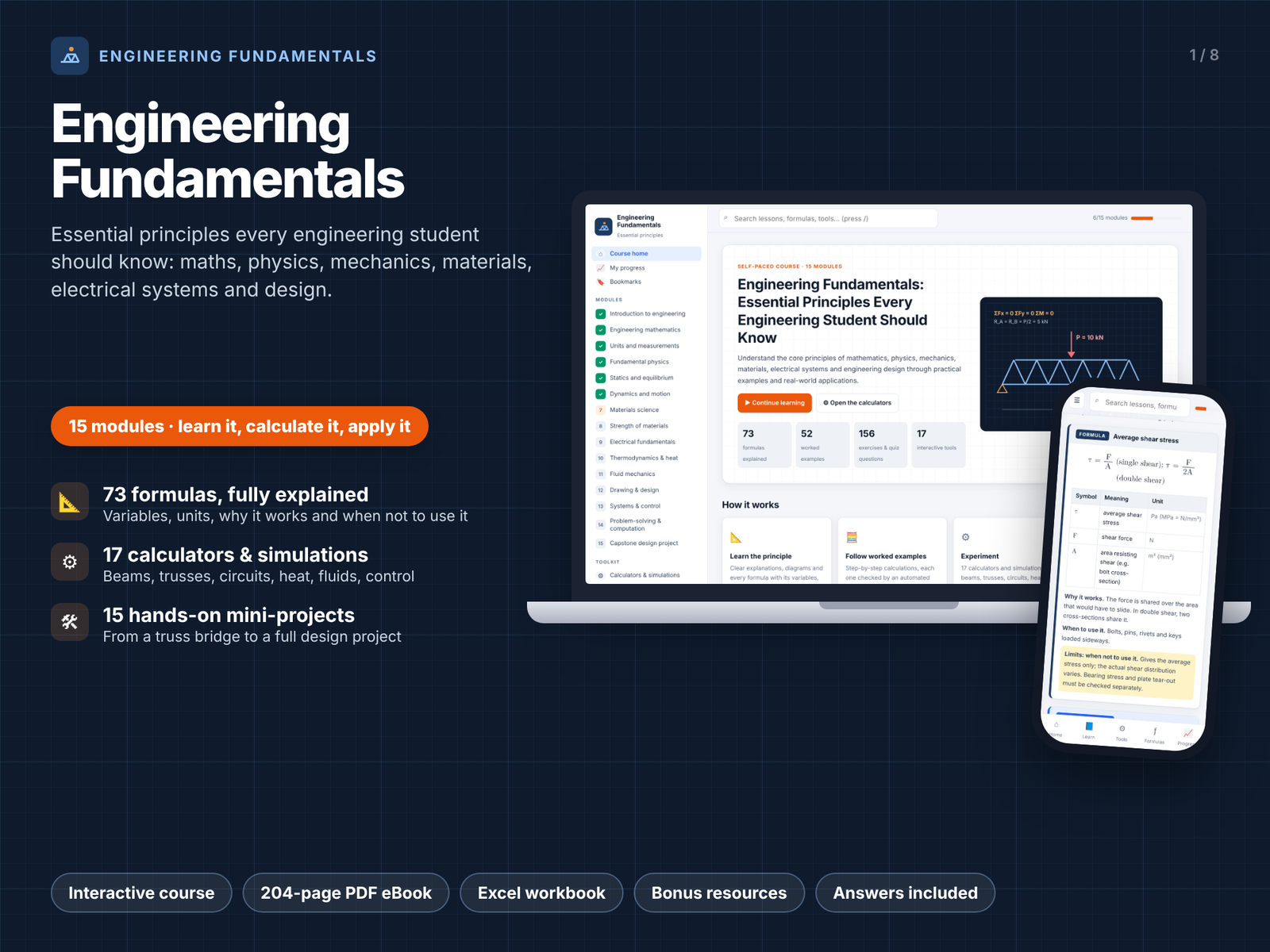
This is a complete self-study course for first-year engineering students, people preparing for an engineering degree, technicians and curious learners. Every idea comes with a worked example, a diagram, an interactive tool and a practical project.
What you’ll learn (15 modules)
- Introduction to engineering and the design process
- Engineering mathematics: algebra, trigonometry, vectors and graphs
- Units, conversions, significant figures and uncertainty
- Fundamental physics: forces, energy, power and efficiency
- Statics: free-body diagrams, moments, beam reactions and trusses
- Dynamics: motion, Newton’s laws, inclines and projectiles
- Materials science: stress, strain and material selection
- Strength of materials: bending, shear, torsion and deflection
- Electrical fundamentals: Ohm’s law, circuits, power and safety
- Thermodynamics and heat transfer: U-values and cooling
- Fluid mechanics: pressure, buoyancy, continuity and Bernoulli
- Engineering drawing: projections, dimensions and tolerances
- Systems and control: sensors, feedback and on/off vs proportional control
- Problem-solving and computation: estimation, spreadsheets, bisection and Euler’s method
- Capstone design project: a wall-mounted shelf, from requirements to testing
What’s included
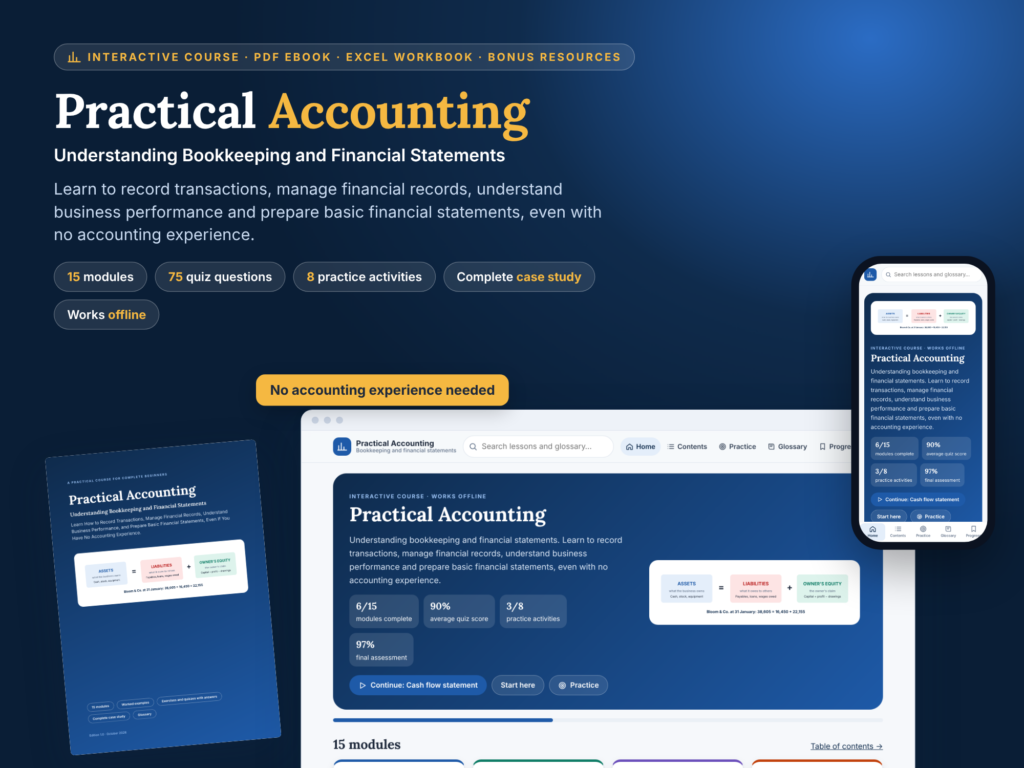
✔ Interactive HTML course: one file that works offline on computer, tablet or phone. It includes search, progress tracking, bookmarks and print-friendly pages.
✔ 17 calculators and simulations: a beam calculator with shear and moment diagrams, plus truss forces, projectile motion, an inclined-plane explorer, a circuit and voltage-divider calculator, wall U-values and cooling curves, pipe flow, tolerance stack-up, a control simulator, a unit converter and more.
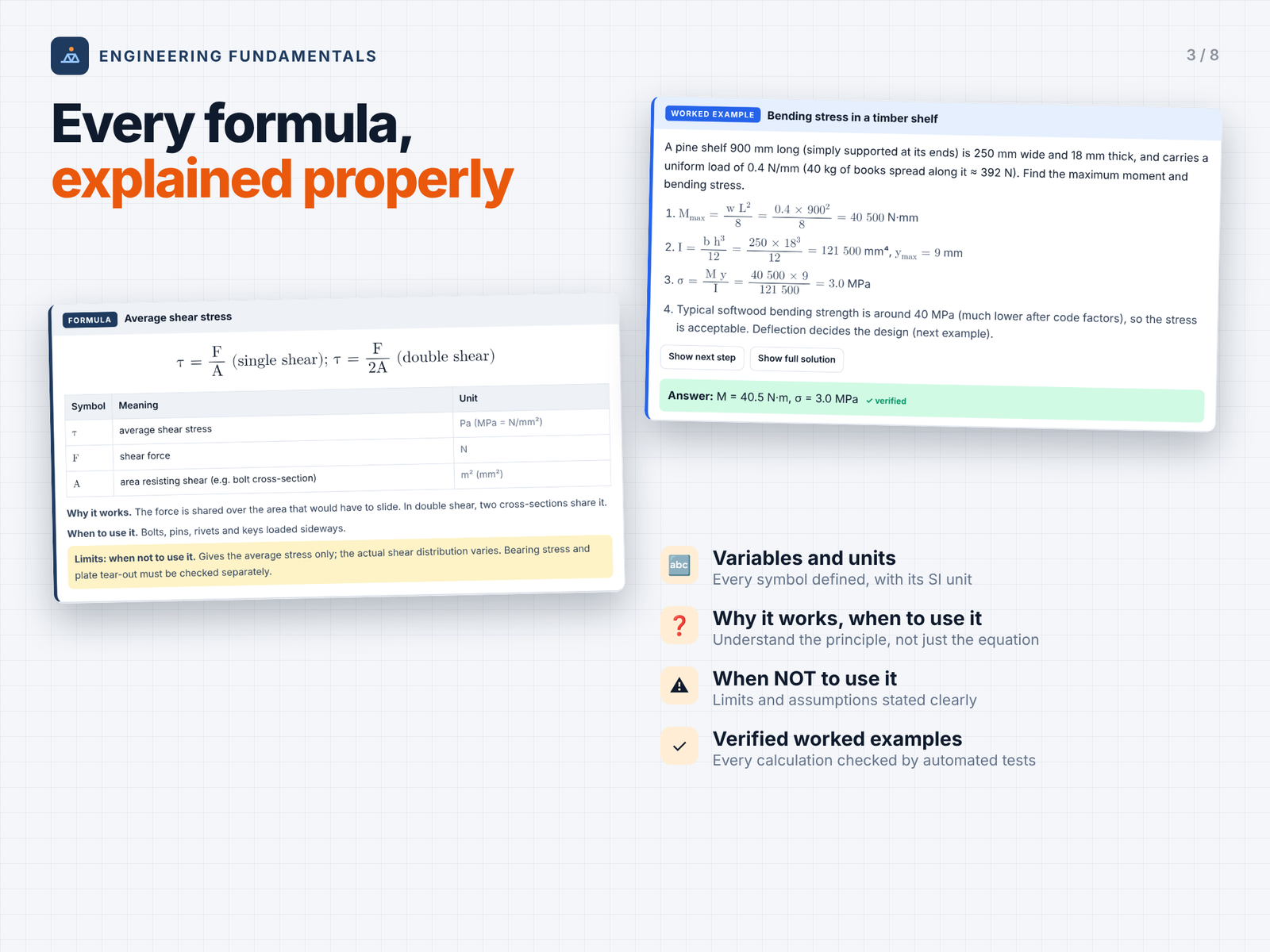
✔ 73 formulas, fully explained: every variable with its unit, why the formula works, when to use it, and its limits.
✔ 52 step-by-step worked examples. Every calculation was checked by automated tests.
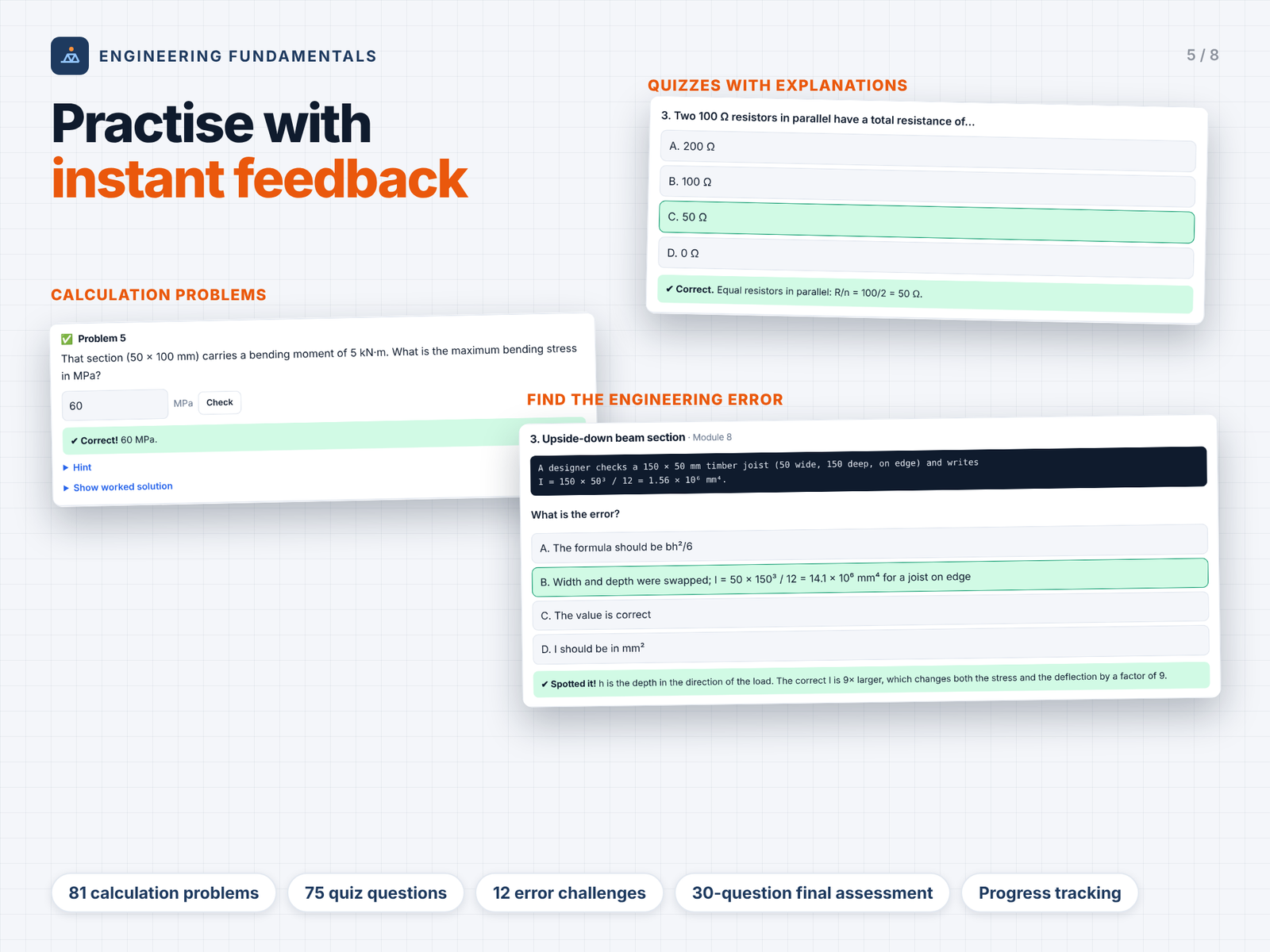
✔ 81 calculation problems with instant answer checking and worked solutions.
✔ 75 quiz questions with explanations, and 12 “Find the engineering error” challenges.
✔ 15 hands-on mini-projects: truss bridge, beam loads, material selection, a low-voltage LED circuit, a household energy audit, a heat-transfer experiment, pipe flow, a technical drawing and a sensor-based system. Each one is labelled conceptual, simulated or supervised physical and comes with safety notes.
✔ 204-page PDF eBook: a clickable contents page, 38 diagrams, projects, a formula quick reference, a glossary and a full answer key.
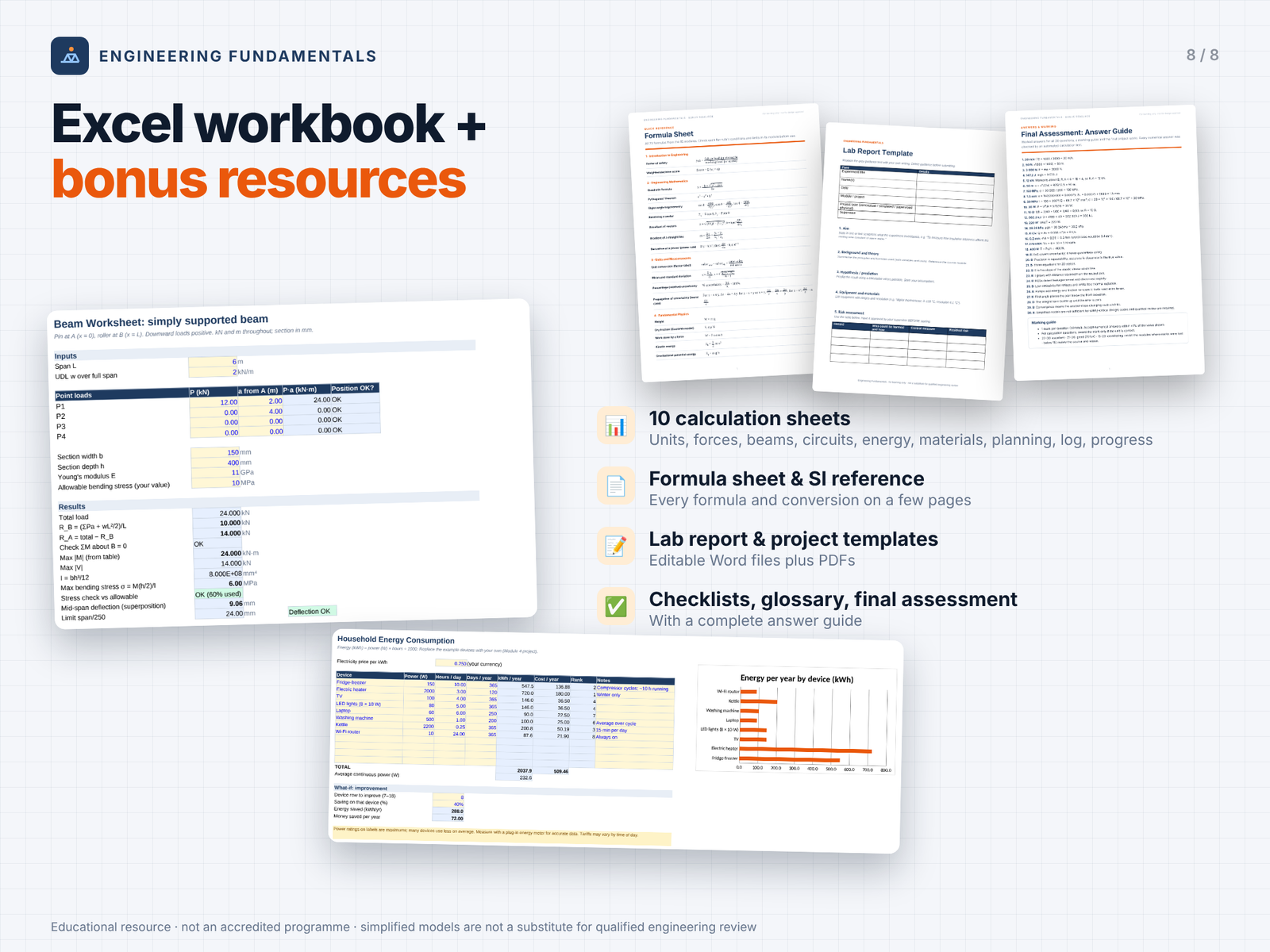
✔ Excel workbook with 10 sheets: unit converter, formula reference, force and equilibrium, beam worksheet with charts, circuit calculator, energy consumption, materials comparison, project planning, calculation log and progress tracker.
✔ Bonus resources:
- Formula sheet and SI units reference
- Problem-solving and technical drawing checklists
- Lab report template and project planning worksheet, each as an editable Word file and a PDF
- Glossary of 100 terms
- 30-question final assessment with an answer guide, plus a rubric for the final project
- ✔ Complete source files and a README.
Who it’s for
- Students starting or preparing for an engineering degree or diploma
- Learners who want to finally understand what the formulas mean
- Teachers and tutors who need ready-made examples, tools and projects
- Makers and career-changers building a solid technical foundation
Important
This is an educational resource. It is not an accredited engineering programme and does not lead to a qualification or guarantee academic results. The models are simplified for learning. They are not sufficient for real structural, electrical, pressure-system or other safety-critical design, which needs applicable codes and review by a qualified engineer. Practical activities are low-risk, should be supervised and use 12 V DC or less.


Reviews
There are no reviews yet.